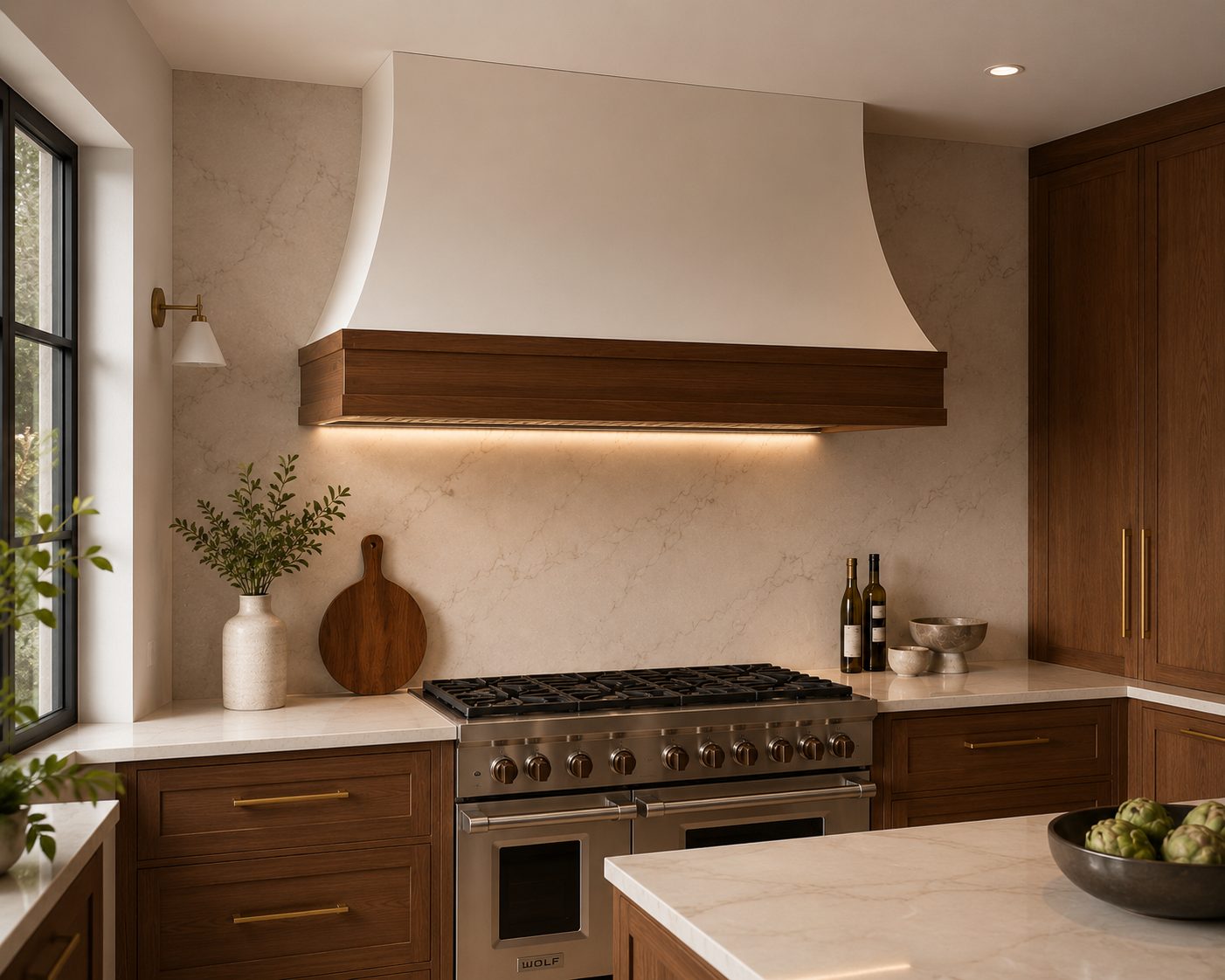
A range hood is the one piece of the kitchen you see from everywhere in the room — and the one most people choose last, off a spec sheet. A wood range hood flips that. Ours are built to order in a range of sizes studied to fit real kitchens — widths matched to standard cooktop sizes, heights matched to ceiling heights — with the ventilation insert engineered in from the start. This guide covers everything you need to choose one with confidence — shapes, sizing, power, finishes, what they really cost, how ordering works, and what to plan for at installation.
Why choose wood?
Stainless steel is the default because it's easy to sell, not because it's right for every kitchen. A wood hood can be finished to disappear into your cabinetry or stand as the room's centrepiece. We don't build one-off custom dimensions — instead, the sizes are studied: three widths matched to the stove sizes kitchens actually have, and four heights matched to common ceiling heights, so the hood you need is already in the line, with no filler strips and no awkward gaps. Each hood is then built to order, in the shape and finish you choose.
The two shapes: bell and curved
Nearly every wood hood is one of two profiles. A BELL hood (our Highland and Summit) sweeps outward in a smooth concave flare toward the base — the classic, furniture-like silhouette that suits traditional, transitional, and farmhouse kitchens. A CURVED hood (our Crestline and Ridgeline) arcs in a softer, continuous bow — a calmer profile that sits well in modern and Scandinavian-leaning spaces. Neither captures better than the other; capture is about size and power, below. Choose the shape the way you'd choose a cabinet door style — by the room it's going into.
Sizing: width, height, and mounting
Size is the decision everything else hangs on. Three numbers matter:
- Width — the hood should be at least as wide as your cooktop, and 3–6 inches wider captures noticeably better. Our hoods come in 36, 42, and 48 inches; a 36" hood houses a 30" insert, a 42" a 36", and a 48" a 42".
- Mounting height — as a general guide, mount 30–36 inches above a gas cooktop and 24–30 inches above electric or induction, and always confirm against your range maker's spec and local code. Too high and smoke escapes capture; too low and it's in your face while you cook.
- Hood height — the four heights (30, 36, 42, and 48 inches) exist for ceiling heights: mounted at the right distance above your cooktop, one of them lands the top of the hood right where it should be, on a standard ceiling or a tall one.
Power: strong enough, and quiet
Every Mirielli hood comes with a Victory Q5 insert rated at 750 CFM — strong enough to pull cooking smoke and smell out of the house completely, so your kitchen and the rooms around it are left with no cooking smell at all. And it does it quietly: the 4-speed all-metal motor gives you full power when you're searing, and a low, quiet speed for everyday cooking. No calculations, no guesswork — the power question is already answered.
The insert: the engine inside the hood
A wood hood is the furniture; the insert is the machine inside it — blower, filters, lights, and controls. It's also where comparisons get dishonest: many wood hoods are priced as an empty shell, with the insert a several-hundred-dollar add-on. Every Mirielli hood includes the Canadian-made Victory Q5 insert: a quiet 750 CFM, 4-speed all-metal motor, dishwasher-safe stainless baffle filters, and both 6-inch and 8-inch exhaust connectors in the box. 750 CFM covers most home and pro-style ranges with room to spare — run it high for a smoky sear, low for a quiet weeknight. When you compare prices anywhere, compare hood-plus-insert to hood-plus-insert.
Ducted or ductless?
Ducted — venting outside — removes heat, moisture, and combustion gases from the house entirely. Ductless recirculates air through charcoal filters: better than nothing, but it can't remove heat or moisture and struggles with heavy cooking. Our hoods are built ducted, with 6-inch or 8-inch ducting; shorter, straighter duct runs always perform better than long ones with many elbows. If your kitchen genuinely can't duct out, talk to us before ordering rather than discovering it at installation.
Noise: a quick word on sones
Hood noise is rated in sones at working speed — roughly, 1 sone is a quiet refrigerator, 4 is a normal conversation, 7+ is a vacuum in the next room. Judge a hood by its sone rating at the speed you'll actually cook at, not just the maximum. A multi-speed blower is the real answer: full power for the ten smoky minutes, near silence the rest of the evening.
Finishes: unfinished, painted, and samples first
Every hood starts as furniture-grade maple veneer over an engineered fiber core. Choose UNFINISHED MAPLE if your painter is matching cabinetry on site, or a factory painted finish — Chantilly Lace, Oxford White, Hale Navy, or Iron Ore — for $650. Painting in our shop means a controlled, furniture-grade finish, cured and inspected before it ships. Deciding between colours off a screen is a gamble at this price: our Finish Set ships you all five colour and wood samples for $39.99, so you can choose in your own kitchen's light.
What a wood range hood costs
Our hoods start at $3,449, with the Victory Q5 insert and free Canada-wide shipping included. Two things move the price: size (36 to 48 inches) and a painted finish (+$650). That's the whole price — no insert upsell, no shipping surprise at checkout. A built-to-order wood hood costs more than a big-box stainless hood, and less than most people expect once the insert is counted: price any competitor as hood + insert + shipping before you conclude it's cheaper.
How ordering works
- Choose your hood — shape (bell or curved), then the model you love
- Choose your size — width and height for your cooktop and ceiling
- Choose your finish — unfinished maple, or one of four painted colours
- Check out — the insert is included; shipping anywhere in Canada is free
- We build it — every hood is made to order in our shop; unfinished hoods ship within three weeks, finished hoods within four.
- Follow it home — you'll get an email at every stage: order received, in production, ready to ship, shipped with tracking, and delivered
Installation: what to plan for
- Duct path — plan the shortest, straightest route outside; every elbow costs airflow
- Duct size — 6-inch or 8-inch, both connectors included with the Q5; don't neck an 8-inch blower down to a small duct
- The crate — your hood arrives in protective plywood packaging; inspect it on arrival before signing, and keep the packaging until the hood is checked over
- Professional installation — a built-to-order hood is heavy furniture plus ductwork; most customers have their contractor or cabinet installer mount it
Our policies, in plain terms
Every hood is built to order, so all sales are final — we can't restock a hood made in your size and finish. Your hood ships within three weeks of ordering for unfinished, four weeks for a painted finish, free anywhere in Canada. And every hood carries a 3-year craftsmanship warranty: if something fails because of how we built it, we make it right. Normal wear and tear isn't covered.
Care and maintenance
Day to day, there's little to do: the stainless baffle filters pop out and go in the dishwasher — monthly if you cook often. Wipe painted finishes with a soft damp cloth; unfinished maple takes whatever care your painter's finish calls for. A hood that's easy to keep clean is a hood that keeps performing, because clogged filters are the number one cause of a "weak" hood that isn't weak at all.
For designers, builders, and cabinet shops
Trade partners get their own login and trade pricing, with a sales rep who knows the product line. If you spec kitchens for a living, apply through "Partner With Us" on the site — a wood hood program is an easy way to give clients something your competitors' catalogues don't have.
The hood is the one piece of the kitchen you see from everywhere. Choose it on purpose.
However you buy, buy the whole system — shape you love, size that covers the cooktop, power matched to the range, and an insert included in the price. That's exactly how every Mirielli is built: choose your model below, pick your size and finish, and the ventilation is already handled.